 Review
Online gambling has evolved from a niche digital activity into a massive global industry. Today, it attracts hundreds of millions of users and generates billions in revenue annually. Driven by mobile access, legalization, and technological innovation, the sector is expanding rapidly across regions and demographics.
This article explores the latest online gambling statistics for 2026, including market size, global participation, revenue trends, and key risks shaping the industry.
Global Online Gambling Market Size & Growth
The global online gambling industry continues its strong upward trajectory. In 2026, the market is estimated to reach $101.45 billion, with projections suggesting it could grow to nearly $168 billion by 2031, reflecting a CAGR of over 10%.
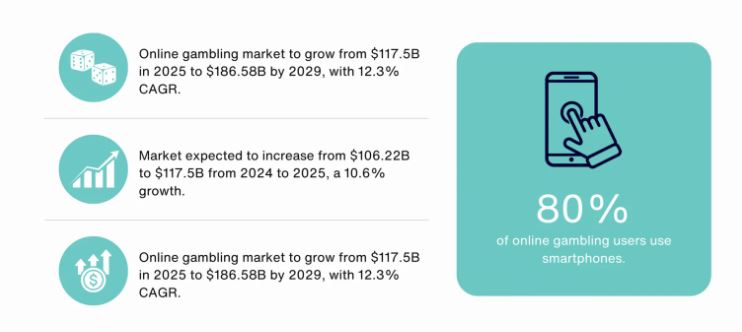
At the same time, some reports indicate even faster expansion. The market is expected to grow from $117.5 billion in 2025 to $186.58 billion by 2029, highlighting how quickly digital betting platforms are scaling worldwide.
This growth is largely fueled by:
- Increased smartphone penetration
- Expansion of legalized markets
- Rising popularity of live and in-play betting
- Growth of digital payment systems
Mobile devices alone account for a major share of industry activity, with nearly 80% of users accessing gambling platforms via smartphones.
How Many People Gamble Online Globally?
Online gambling participation has reached significant levels worldwide. Current estimates suggest that around 17–20% of the global population has engaged in gambling activities within the past year. This translates to nearly 1 in 5 people globally. (Source: The Lancet)
Among adolescents, participation is also rising. About 17.9% of young people reported gambling in the past 12 months, highlighting early exposure to betting platforms.
Looking ahead, the user base is expected to grow rapidly. By 2030, the global gambling audience could exceed 1.1 billion users, with online casino players alone projected to reach nearly 140 million by 2029. (Source: Statista)
In India, the online gambling market had an estimated 12.7 million users, with steady growth projected in the coming years. (Source: 360 info)
User penetration globally is expected to increase from 3.0% in 2024 to 3.7% by 2029, reflecting gradual but consistent adoption. (Source: Casino Statistics)
Regional Market Trends
1. Europe: The Largest Market
Europe continues to dominate the global online gambling industry, accounting for nearly 49% of the total market share. Countries like the UK, Italy, Germany, and France lead in revenue generation.
The UK stands out due to its high online penetration, where more than 50% of gambling revenue comes from online platforms.
2. North America: Fastest Growth
North America is one of the fastest-growing markets due to legalization across U.S. states. The U.S. online gambling market has surged from $2.5 billion in 2018 to nearly $20 billion in recent years, with projections of reaching $40 billion by 2029.
More than 30 U.S. states have legalized online sports betting, contributing to rapid growth.
3. Emerging Markets
Countries like Brazil are becoming key players. Brazil’s regulated market is expected to reach 22 million active users, generating billions in revenue.
Meanwhile, regions like Asia and Africa show lower online penetration but hold massive growth potential due to large populations and improving digital infrastructure.
User Demographics & Behavior
Online gambling usage varies significantly across demographics:
- Men dominate participation, with around 20.4% of men gambling online compared to 11.2% of women
- However, female participation is growing steadily
- The 18–34 age group represents the most active segment
- Younger users (18–24) are the fastest-growing demographic
In the United States, over 50% of adults have engaged in some form of gambling, showing how mainstream the activity has become.
Mobile-first usage has also transformed behavior. Users now prefer quick, real-time betting experiences, especially through live sports betting and in-play wagers.
Popular Gambling Segments
Different gambling formats contribute differently to market revenue.
Sports betting remains the most dominant segment, accounting for a large share of online gambling activity. Games like basketball, football, and cricket attract the highest number of bettors.
Live betting is another major trend, now making up over 50% of all betting activity, as users prefer real-time engagement.
Online casinos, poker, and slot games also contribute significantly, especially in regulated markets like Europe.
Economic Impact of Online Gambling
The online gambling industry plays a significant role in the global economy.
In regulated markets, it contributes through:
- Job creation
- Tax revenue
- Growth in tech and entertainment sectors
For example, in the United States, the gambling industry contributes billions in tax revenue and supports millions of jobs.
Globally, the industry is projected to generate over $150 billion in annual revenue by 2030, making it a major component of the digital economy.
Risks & Social Impact
Despite its growth, online gambling comes with serious concerns.
Globally, around 450 million people experience gambling-related harm, while approximately 80 million suffer from gambling disorders.
In the U.S. alone:
- Up to 10.5 million adults are at risk of gambling harm
- Social costs are estimated at $14 billion annually
(Source: The National Council on Problem Gambling)
Additionally:
- Around 50% of problem gamblers report suicidal thoughts
- Nearly 17% have attempted suicide
These figures highlight the darker side of rapid industry expansion.
The ease of access, 24/7 availability, and digital payment systems increase the risk of addiction, especially among younger users.
Technology & Future Trends
Technology is playing a crucial role in shaping the future of online gambling.
Key trends include:
- Mobile-first platforms dominating user access
- Growth of crypto and blockchain-based betting
- Use of AI for personalization and fraud detection
- Rise of live and social betting features
Stablecoins are expected to power a large share of crypto-based gambling transactions, while immersive technologies like VR may redefine user experiences in the coming years.
